

Ecommerce brands now have more ways than ever to show off a product, and two of the most common approaches often get compared head-to-head: polished traditional product photography and AI-generated, UGC-style video content. Store owners are increasingly asking which one is actually worth the investment.
The honest answer is that neither one wins outright. Each format tends to perform differently depending on where it’s used, what the product is, and what stage of the buying journey the shopper is in. Understanding those differences is more useful than picking a side.
This article breaks down what each format does well, where they tend to convert better, and how to think about combining them rather than treating it as an either-or decision.
What Traditional Product Photography Does Well
Traditional photography remains the standard for a reason. It gives shoppers an accurate, detailed look at exactly what they’re buying — true colors, real textures, and precise proportions. For products where accuracy matters, like apparel, furniture, or anything with fine detail, this level of precision is hard to replace.
Photography also supports consistency. A well-shot product catalog looks cohesive across every listing, which builds a sense of professionalism and reliability. It’s also the format shoppers expect to see on a product page itself — it feels neutral and factual rather than persuasive, which is exactly what’s needed at the point where someone is trying to confirm a purchase decision.
What AI-Generated UGC-Style Video Does Well
AI-generated UGC-style video content solves a different problem: it’s fast, relatively low-cost to produce compared to traditional video shoots, and it mimics the casual, relatable format that performs well on social feeds. Shoppers have grown used to seeing product recommendations that feel like they’re coming from a real person rather than a studio production, and this format taps into that expectation.
It also makes it realistic to test more variations. A brand can produce several different scripts, hooks, or angles quickly and see which one resonates, something that would be far more expensive and slower to do with traditional video production. For top-of-funnel content — ads, social posts, and anything meant to stop a scroll — that kind of speed and relatability tends to matter more than technical precision.
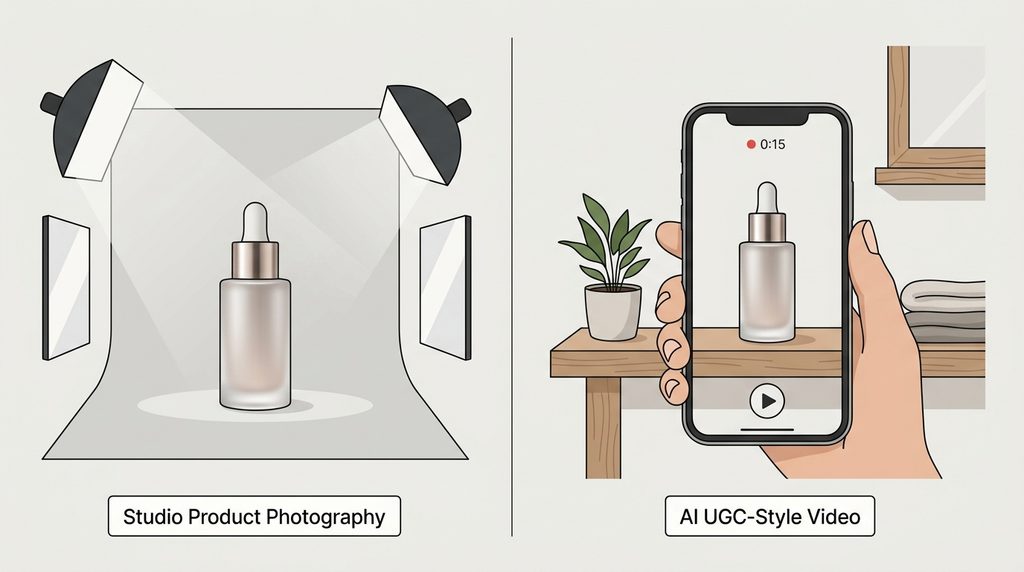
Side-by-Side Comparison
| Factor | Traditional Photography | AI UGC-Style Video |
| Cost | Higher (studio, equipment, models) | Lower, especially for iterations |
| Speed | Slower turnaround | Fast, easy to product variations |
| Accuracy | Very high – true to product | Good, but not a substitute for real detail shots |
| Best used for | Product pages, catalogs | Ads, social feeds, top-of-funnel content |
| Feels most natural on | Store website | Instagram, TikTok, paid social |
Where Each Format Tends to Convert Better
Photography tends to convert better in places where a shopper is already interested and trying to confirm the decision — product pages, catalogs, and anywhere someone is comparing details before checking out. This is where accuracy and clarity matter most.
AI UGC-style video tends to convert better earlier in the journey, in places like paid social ads or organic content feeds, where the goal is to capture attention and create initial interest. It works because it feels native to the platform rather than like a traditional ad.
Trying to use the wrong format in the wrong place often underperforms. A highly polished studio photo can feel stiff and out of place in a fast-scrolling social feed, and a casual AI-generated video clip can feel underwhelming on a product page where a shopper wants precise detail.
Does “AI-Generated” Hurt Credibility?
This is a fair question, and the answer depends heavily on execution. Content that looks obviously synthetic — unnatural movement, mismatched lighting, or a voice that doesn’t quite land — can undercut trust rather than build it. Shoppers are increasingly good at spotting content that feels artificial, and a poor execution can do more harm than not using video at all.
The content that performs well tends to be produced carefully enough that it doesn’t call attention to how it was made. The goal isn’t to hide that AI tools were used; it’s to make sure the final result still feels genuine, useful, and well-produced rather than gimmicky.
The Real Answer: It’s Not Either/Or
Most ecommerce brands that get the best results aren’t choosing one format over the other — they’re using each where it fits. Traditional photography carries the product page and catalog, where precision and trust matter most. AI-generated UGC-style video carries the top of the funnel, where speed, relatability, and the ability to test multiple angles matter more.
Final Thoughts
The question isn’t really “which one converts better” in isolation — it’s “which one converts better for this specific placement and this specific stage of the buying journey.” Traditional photography and AI-generated UGC-style video solve different problems, and the strongest ecommerce content strategies tend to use both deliberately rather than treating it as a competition.
FATISCO STACK INDUSTRIES helps ecommerce businesses produce both traditional and AI-assisted creative content, matched to where it will actually be used and what it needs to accomplish.